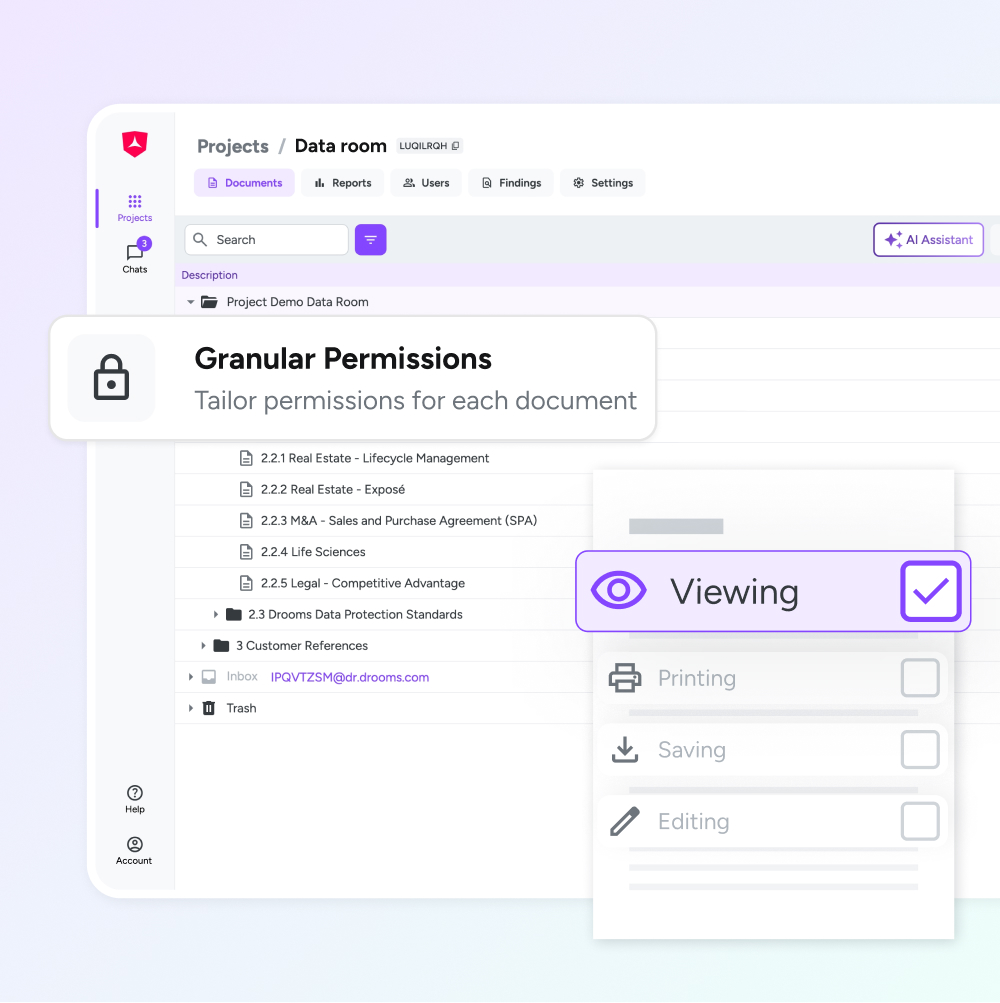
In this case, Drooms was used for a single, very specific purpose, which was centralising communication with creditors during the financial restructuring. The key challenges were clear from the outset: version control, granular permission management, and especially the ability to audit access to sensitive documentation down to each individual action.
“In a financial restructuring involving multiple external parties, a lack of precise traceability generates legal and operational insecurity. In this process, that was simply not something we could afford,” says Elena. With Drooms, the team had a platform designed to minimise those risks, ensuring that every access, download, or interaction with documents could be tracked and reported with full rigour, supported by detailed audit logs whenever procedures or disclosures were questioned.
Although the restructuring itself was relatively short and therefore difficult to quantify in exact numbers, Duro Felguera observed a significant increase in operational efficiency compared to commodity tools such as SharePoint. Elena notes that: “Operational efficiency improved significantly with Drooms. The reduction in time spent managing access, locating documents, and generating audit reports represented real savings in internal team hours and, above all, in speed of response to external requests from lawyers requiring evidence of who accessed what and when.” Time spent managing access rights, searching for the correct documentation, and compiling audit reports dropped noticeably, freeing internal resources and accelerating responses to external requests.
This was particularly important in interactions with lawyers and other advisers, who often needed fast, accurate evidence of who accessed which information and when. “When lawyers are involved, being able to respond quickly, precisely, and concisely builds trust with third parties. It reduces back and forth emails, calls, and disputes. A fast, accurate answer in a short timeframe significantly increases the confidence of external parties.” From initial evaluation and contracting through to closing, the full process lasted just over six months.
While Duro Felguera did not actively use Drooms’ AI features such as translation, redaction, or the AI assistant during this particular project, the direction of travel is clear. “In this particular case, we did not use them – the process was relatively short and straightforward,” says Elena. “That said, it is a direction we value highly. It aligns with our approach to optimisation and, importantly, it fits within our security and confidentiality requirements. The fact that the AI is embedded within a platform we consider 100% secure is a real enabler.”
Sovereignty, however, was non negotiable and ultimately decisive in the choice of platform. “Digital sovereignty it was a decisive factor,” Elena states. “For us, knowing where data resides is critical. The fact that Drooms is a European platform subject to European data protection regulation was a determining element. Sovereignty is non negotiable in processes of this nature. I would also add: even if another platforms may appear more innovative with their AI integrations, companies should ultimately care far more about security. I would rather have less optimisation and less visual impact, but 100% guaranteed security.”


 your whole data room answerable, extractable, reportable. More information